Monday, April 30, 2012

Wampa World Water – Can Taunton fill the need?


Unlike other proposed casino complexes in Massachusetts, the recently unveiled plans for Taunton present a significantly different environmental impact profile.  Mashpee Wampanoag council chair Cedric "Pay no Taxes" Cromwell promises a massive indoor and outdoor water park along side of his planned casino resort complex with three hotels (nearly 1,000 rooms) multiple  restaurants, bars, a “New Hampshire style” liquor store and shopping mall.    

The Wampanoag claim they have an environmental impact study underway; however, residents are being asked to vote on the casino issue and the town is negotiating a compact before that study will be made available and the potential cost burdens this Indian reservation casino resort complex will have on the area's infrastructure and environment.  The impact of this resort casino, hotels, restaurants and water park on local water use and treatment alone will be huge for Bristol County.

According to the latest state government report, Southeastern Massachusetts is under “severe drought” conditions.  Bristol County residents have been under water use restrictions each summer for several years now.   How will Cathal O’Brian and Taunton Water address this new demand?   What will the burden be on infrastructure for treating the casino’s waste water?  How will this new draw impact neighboring communities who share our water sources needs?  

While any potential agreement between the City of Taunton and the Mashpee Wampanoag must fully account for water use and treatment costs, other factors also need to be included: the neighboring communities’ costs, risks to local firefighting capacity, environmental impacts and additional water restriction burdens on the people in the region should be equally addressed.

According to industry standards, hotels typically use between 36,000 and 73,000 gallons of water per room/year.  So, Cedric’s three hotels alone could draw down 66 million gallons of Taunton-area water.   Hotel & Leisure Advisors reports that a typical indoor only (Cedric promises and indoor and outdoor water park) park requires 50 million gallons to fill, then uses between 125,000 and 160,000 gallons per day (that’s 46 to 58 million gallons per year).   Using standard calculations for casino, restaurant, bar and shopping space water usage the proposed Wampanoag gaming complex, bars and restaurants would conservatively use another 200,000 gallons of water per day or 74 million gallons per year.

The combined annual water draw down from the area’s water supplies and corresponding waste water output from the Taunton Wampanoag casino resort complex would be in excess of 250 million gallons per year.   To put that into context, the average single family household of four uses 60, 000 gallons per year – thus the casino will have the water impact of adding another 4,000 single family homes.

The City of Taunton, Massachusetts draws its drinking water from six reservoirs: Assowampsett; Elders; Long; Poksha; Great Quittacas; and Little Quittacas.  Taunton shares this water with Lakeville, Middleborough, Freetown and Rochester.  The Massachusetts Energy and Environmental Affairs report on Sustainable Water Initiatives, published in February 2012, details the water challenges for the state and for Taunton.  This report, coupled with the current "severe drought" status of the region, spells out real challenges for Bristol County with the proposed Indian casino resort complex.

To ensure regional, not just Taunton residents, aren’t unfairly penalized for the infrastructure costs and new water demands that will stretch the region’s already limited capacity the City should review and revise their commercial water rate schedule for this project, as even a high commercial rate of $10 per 1,000 gallons will not likely cover the resulting costs.  Other commercial rate payers also pay state and local taxes which are used to support area infrastructure – the Indian reservation casino complex will pay no such taxes and their utility rates should reflect that disparity.

Finally, what assurances will Taunton have that the Wampanoag casino will be able to pay increasing water and other utility costs when other established Indian casinos in our region are now in massive debt and tribe members are seeking assistance to pay their utility bills?  Does anyone really think an Indian casino in Massachusetts will be any different.

Friday, April 27, 2012

Amazing video testimony on impact of casinos

Over promising and under delivering.  This video produced by concerned citizens in Foxboro, MA and it provides firsthand accounts from Connecticut residents of the impacts of the Mohegan Sun and Foxwoods Indian casinos on their small New England towns.


The local Connecticut communities bordering the casinos saw increases from 2,000 – 4,000 cars a day to 30,000 vehicles plus with constant traffic 24 hours a day and seven days a week from casino goers, employees and vendors.  Local roads, not state highways, became the routes of choice for casino employees and delivery trucks.  The increased traffic brought with it increased accidents and the highest drunk driving rates in the state. 

The character of towns around casinos in Connecticut dramatically changed with lower-rent housing developments to support low-income casino workers.   Casino workers in Connecticut are “hot bed” sharing rooms near the casino with shift workers rotating in and out of rented homes that are now no longer maintained and dragging down the values of their neighbors.  Connecticut towns found an average of 20 percent loss in property values on routes used to and from the casinos.

Local businesses were put out of business and boarded up. A 2009 report by State of Connecticut found the number of gambling treatment clinics increased from 1 to 17 clinics.  Embezzlement arrests linked to problem gamblers rose from 43 to 214 after the casinos opened.  The embezzlement-related costs to Connecticut businesses and municipalities was $7.5 million.  Every town and business within 15 to 20 miles now has higher accounting and insurance bills associated with these embezzlement risks. 

Costs for local school districts near Connecticut casinos also increased by more than $2 million per year to pay for ESOL and other mandated and special program costs associated with influx of lower-income casino workers’ children.


Taunton casino dreaming, is it just that?

Taunton Mayor Tom Hoye joined the stage yesterday with Mashpee Wampanoag chairman Cedric "We will crush the competition by paying no taxes" Cromwell and proclaimed that a proposed Indian casino approval process would mark the most important period in the City's history!  Our city historians may find the Mayor's juxtaposition of an Indian casino resort development in the same historical context as Taunton's American Revolution legacy or role in bringing about the industrial era in the United States with skepticism, but the Mayor's intentions of bringing needed prosperity to the City are good.  But good intentions are just that if not coupled with reality.  And, press conference promises and theater from a Tribe known for reneging on such promises to other communities do not equal reality.


Put aside whether or not the people of Taunton can trust the Mashpee Wampanog and Cedric Cromwell to keep their promises.  Let's be clear about some critical and real hurdles which need to be cleared before this casino dream of historical proportions becomes more than a laundry list of promises from the Tribe for which the City of Taunton will have no recourse or ability to enforce. The Massachusetts gaming law spells out that a federally recognized tribe, like the Mashpee Wampanoag, must have a deal in place and overcome specific barriers they face by July 31, 2012 or the state must open up the casino application process to non-Indian commercial gaming interests.  What are those barriers?


1. An Act of Congress.  An Act of Congress is required to change current law which prohibits the Mashpee Wampanoag and other recently recognized tribes from taking lands into trust.  Having a land in trust reservation is a requirement for establishing an Indian casino. This is based on the 2009 Supreme Court Carcieri v. Salazar Decision which makes it illegal for the U.S. government to turn over lands in trust to Indians who were not federally recognized prior to 1934.  The Mashpee Wampanoag only became a federally recognized tribe in 2007.

This required legislative change is called the "Carcieri Fix" and has been unsuccessfully introduced in Congress each year since the 2009 ruling.  The Carcieri Fix legislation faces strong opposition from elected officials with existing recognized tribes who have established gaming operations.  And states neighboring Massachusetts, like Rhode Island, Connecticut and New York, which have existing gaming that will suffer from Massachusetts Indian gaming competition, can also be counted on to now oppose this fix as well. Several U.S. Senators, including Diane Feinstein, John McCain and Jon Kyle have openly stated their opposition to this legislation (hint: it only takes one senator to block a bill).  Further, these Senators have introduced counter legislation called the "Off Reservation Land Acquisition Guidance Act" and the "Tribal Gaming Eligibility Act" which will make the Mashpee casino bid even less likely to get approved if a fix to Carcieri is ever passed.   No "Carcieri Fix" legislation is currently scheduled for consideration in 2012 and the chances of it passing in an election year is non-existent.  No new law, no Indian casino for Taunton.


2. Approval from the Department of the Interior.  The Department of the Interior has an application process which can take up to 15 years and for which less than half of applications are approved.   The Mashpee Wampanog's last application filed was rejected. The application process includes requirements that the land in trust have the support of Members of Congress and state elected officials - and not just in Massachusetts. 

Neighboring Rhode Island and Connecticut have sufficient proximity with existing Indian reservations and gaming to claim another Indian casino will have a negative economic impact on them - which is grounds to block approval.  Casino proponents, in announcing studies showing that Massachusetts residents spend hundreds of millions at Connecticut and Rhode Island casinos, have already made the case for these states to oppose any new Indian casino in Massachusetts.  These states have no recourse to block a non-Indian gaming operation, but all they need do to prevent a new Indian reservation casino is show that it will take business away from their Indian casinos - which the recent Massachusetts studies do for them.

Rhode Island has already commissioned their own study and is preparing their case to block any Massachusetts Indian casino project on the South Shore.  Governor Chafee has publicly pledged to oppose any fix to Carcieri and to block any application within 50 miles of his state's Twin Rivers complex The Taunton casino site is closer to Twin Rivers than it is to the Mashpee Tribe's headquarters (Twin Rivers is about 20 miles from Taunton, while the Mashpee's existing reservation is more than 50 miles away).


This Department of Interior application process also requires that the interests of other tribes be considered. Any recognized tribe with cause may intervene to protest a new application for land in trust.  The Pocasset Wampanog are disputing the Mashpee's territorial claims to the Taunton site and the Aquinnah have announced they will file a lawsuit to block them as well.  Given that the Mashpee Tribe's own enrollment ordinance states that you cannot qualify for membership in the tribe if you live further than 20 miles from Mashpee, MA they are going to have a hard time defending a territorial claim to Taunton.  Either of these tribes or opposition from the Narraganset Tribe in Rhode Island or Mohegan in Connecticut will be enough to derail the Mashpee's application process.


All the other lawsuits and opposition aside, these two requirements - which must be addressed by July 31, 2012 - make the proposed Indian reservation casino resort complex for Taunton more dream than reality.

Thursday, April 26, 2012

Casino impact on Taunton neighbors: Berkley, Dighton, Raynham, Lakeville, Middleboro and Norton


The Berkley, MA town selectmen are asking Taunton Mayor Tom Hoye to include them in impact studies and negotiations with the Mashpee Wampanoag and their plans to build a mega-casino Indian reservation resort complex in East Taunton.  Berkley recognizes that Taunton will not be the only impacted community.  Are the other neighboring communities of Dighton, Raynham, Lakeville, Middleboro and Norton also preparing?

Well documented independent research from respected, non-casinofunded sources clearly shows neighboring communities also suffer from increase crime, traffic and others costs with casino gaming developments.  Casino promoters claim "mixed" data proves the casinos are not the cause, but reductions in murder rates while clearly casino-linked crimes like rape, assaults, car thefts, robberies and DUIs increased are easily measured.    Studies of casinos in suburban areas similarly show a corresponding loss in property values based on residential proximity to a casino.  The casino promoters only talk about studies done on remote location casinos where property values started at zero.  These property value losses can be measured miles beyond the borders of the towns in which the casinos are located.

Take the case of the small community of Ledyard, Connecticut.  Their downtown center is located about five miles from the Foxwoods Indian Casino resort complex.  Ledyard conducted a study of the impact andcosts they bear as a neighbor to the destination resort casino – similar to the one proposed for Taunton by the Mashpee Wampanoag tribe – and found the following results:

  • 24 hour a day traffic increases resulting in increased traffic control and road maintenance
  • Increased motor vehicle accidents resulting in the need for more police enforcement and emergency response
  • Increased drunk driving (DUI) incidents – which they note, now occur at the highest frequency rate of any location in the state – with corresponding police and emergency medical service response costs


Ledyard could directly quantify the costs of these new burdens by comparing their costs and incidence rates in previous years.  In addition to what the town characterizes as serious negative impacts on their quality of life of residents, they could attribute more than $2.2 million in direct additional costs to the town annually.  The broke them down as follows:


Expense area
Cost to town
Crime
$336,084
Social Services/ Assistance
$5,098
Legal expenses (lawsuit with tribe over attempted annexation of town land)
$370,000
Local roads and bridges
$1,200,000
Zoning enforcement
$49,864
Public safety & traffic
$260,930
Total 2000-2001 costs incurred:
$2,221,976


Ledyard further noted annual erosion in their property tax base concurrent with the casino development and annexation of previously taxed lands for the purposes of expanding the Pequot Indian reservation.
The town acknowledges that the casino has brought new jobs to the region, but notes that the majority created were in the low $15,000 to $25,000 per year range. They noted that the low paying jobs and increase problem gambling associated with the casino proximity were linked to a significant rise in demand for local social services and general assistance programs.

In addition to moving from one of the lowest DUI rates to the highest in the state, Ledyard experienced a 300 percent increase in local crime rates.  This increase happened during the same time when crime rates outside of the casino region in Connecticut declined by 11 percent.

Ledyard also saw a 200 percent increase in traffic on local roads.  They note that casino customers are using local roads at significantly higher rates than the state highways which had been touted in initial impact plans as bearing the majority of the traffic burdens.  They further noted that the increased cars and trucks were not contributing to a corresponding increase in visits to Ledyard businesses, but was simply through traffic to the casino complex.

And, Ledyard noted that because Foxwoods was an Indian casino, that the construction process circumvented all local zoning, public hearing requirements and environmental regulations for which the town then incurred significant legal costs to protect their citizen’s interest throughout the development, building, ongoing operation and expansion process.

Taunton will not be the only place that needs to negotiate with the Mashpee Wampanoag tribe to make sure their costs don’t outweigh the promised benefits of bringing a free from local jurisdiction and tax exempt Indian reservation casino resort complex to their community.  Will the impacted citizens and businesses in Dighton, Raynham, Lakeville, Middleboro and Norton have any say or control?

Wednesday, April 25, 2012

Mashpee Wampanoag Taunton Casino: Trust but verify, if you can


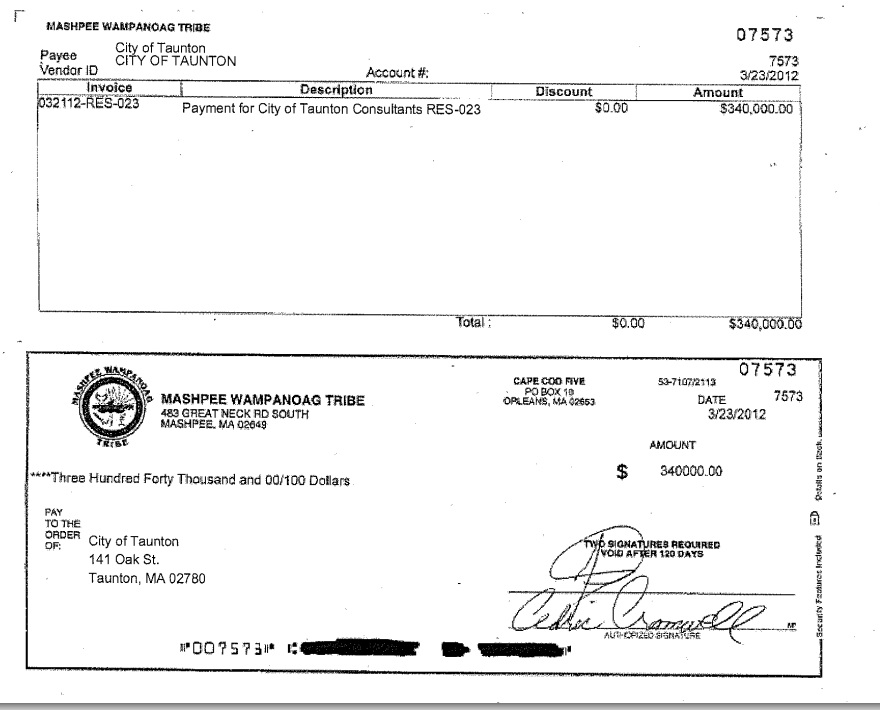
On March 23, 2012 the City of Taunton received a $340,000 check from Cedric Cromwell and the Mashpee Wampanoag Indians to cover the costs of the upcoming special election ($40,000), consultants and legal counsel for negotiating with the tribe ($300,000). Since it didn't bounce, this check seals the deal on an agreement entered into by the City and the Mashpee-based Tribe to move forward with turning over control, including local jurisdiction, for lands in Taunton for an Indian casino resort complex.    

Just don’t be surprised if that $300,000 payment is not nearly enough to cover the legal expenses the town will face in dealing with the Cromwell led-Mashpee Wampanoag tribe and his Malaysian-backed reservationcasino resort syndicate.  Taunton need not look far when doing diligence on the Mashpee Wampanoag and Cedric Cromwell to anticipate the likelihood of success in this endeavor.

The Tribe itself commissioned an assessment of the Mashpee Wampanoag from Harvard University on their ability to govern themselves, achieve progress against stated goals and successfully engage effectively with other entities.  This report, delivered to Tribal Council Chair Cedric Cromwell in 2011 but never shared with the tribe, found that a lack of transparency, unclear goals, a lack of oversight against initiatives “limited the degree of legitimacy conferred upon current activities” of the Mashpee Wampanoag tribal government.  Yikes.  Who can blame Cedric for trying to keep those findings secret while he was negotiating a gaming compact with such “entities” as the Commonwealth of Massachusetts and local governments in: Middleboro, Mashpee, Raynham, Fall River and now Taunton…

And what do we hear from all those other localities which have past dealings with this “limited legitimacy” branded Wampanoag group?  There are many important lessons from other Massachusetts towns dealing with the Mashpee Wampanoag tribe which should be considered by Mayor Tom Hoye and other Taunton officials.   

The Town of Middleboro remembers and is currently in court and seeking help from the Governor and other elected officials to be made whole on reneged agreements with the Mashpee tribal council headed by Cedric Cromwell.  Middleboro trusted the Mashpee Wampanoag only to find out months after the tribe was notified that their application for land in trust for that community had actually been thrown outby the Department of the Interior.   How much are Middleboro’s legal bills now and what costs did the Tribe saddle the town with as a result of their less-than-transparent dealings?  Ask Middleboro selectmen Ben Quelle if Taunton should trust the tribe, Quelle told Gatehouse News, “They speak with forked tongues and their signature means nothing. They cannot be and should not be negotiating with other towns…

Even the tribe’s own hometown of Mashpee has had to enlist and pay lawyers to prevent this reservation casino-bent gang from violating agreements with them.  The Town of Mashpee had to have their lawyers write to the U.S. Bureau for Indian Affairs (BIA) on January 25, 2008  to oppose the Tribe’s application for land in trust claiming the Tribe misrepresented and made false claims about agreements with the town in their federal filings.  The town wrote:

Contrary to the Tribe’s assertions in its application, the Town has not yet agreed to transfer to the Tribe any of the Town’s right, title, or interest in and to any of these parcels….” Adding, “The relationship between the Tribe and the Town with respect to land and development has been controversial… while many residents of the Town have expressed concerns to Town officials regarding the Tribe’s proposed and potential future acquisitions of trust land and how the Tribe’s proposed development may affect the region…”

The Mashpee lawyers added, “Although the Tribe has stated that it does not intend to develop any of the Mashpee lands for gaming purposes, it has nonetheless requested on page 2 of the trust land request a determination by the Secretary that all the lands identified in the application constitute the initial reservation of a newly-recognized tribe on which gaming may be conducted… The Tribe’s application indicates that the Town will transfer its title to certain parcels of land…   This is an inaccurate and presumptive assertion by the Tribe…” 

These are kind legal words which suggest the tribe lied on its submissions to the federal government.

Cedric Cromwell and his council cohorts (see image) don't even trust their own tribe members. The Mashpee Wampanoag tribal council recently established a Tribal Gaming Ordinance which appoints Cromwell and his council treasurer Mark Harding in charge of all gaming issues and allows them to negotiate contracts in secret.  Not even members of the tribe are allowed to attend meetings or view documents where Cromwell is putting them into debt to pursue his casino interests.  Cromwell has even created a for-profit real estate holding company, separate from the tribe, called "Project First Light, Inc", which he controls with Harding and two other council members.  First Light is the company being used to make the land deals in Taunton - why the tribe needs a separate for-profit entity through which borrowed tribal funds are laundered with no accounting to members has raised significant concerns among his own people.

If the Mashpee Wampanoag cannot be trusted in their own town or by their own tribe members, and have left a trail of broken promises with other neighboring communities how do we think Taunton will fare some 50 miles away?   No resident of Taunton, regardless of their ancestry, can even qualify to be a Mashpee Wampanoag member – so no ‘neighbors’ with skin in the game to complain to if things go badly.  

Trust but verify.  And if you really cannot verify, all we can go on is past behavior.